[ Back to Historical Fiction ] -> [ Back to Under A War-Torn Sky ]
Why French Dialogue?
Under a War-Torn Sky
Why Include French Dialogue?
Very few of our flyboys could speak French. Hardly any had traveled overseas. And then suddenly they’re on the run in Nazi-occupied territory, hiding from Germans with their only hope being to somehow blend into a country and a French-speaking population that they can’t understand.
Imagine the terror of that.
Our Air Force flew “precision daylight” missions (versus Britain’s RAF nighttime raids), optimizing our navigators’ ability to locate and bombardiers to drop a B-24’s 8,000-pound payload of explosives “right in the pickle barrel”—NOT on civilian neighborhoods in which the Nazis insidiously tried to hide their munition factories. Our planes, shimmering in sunlight, banners of contrails formed in the cold, high-altitude air streaming along behind them, were visible for miles. Easily tracked and attacked—from the ground and the air.
If their planes were hit, flyboys able to parachute out in one piece drifted down through raging, hellfire-loud air battles. People on the ground could see and follow those bright-white plumes as they descended, and German patrols and collaborators hurried out to hunt them.
Winds scattered flyers for miles as they bailed out. They hit earth separated, not knowing the location or fate of their friends. All they had to protect themselves was a pistol and an escape kit containing a miniature compass, water-sterilization tablets, Benzedrine and candy for energy, four morphine syringes in case of injury, a few bills of French money, and a silk map showing cities, major roads, and train lines. There was also a phrase booklet, translating pleas like “help me” or “I’m hurt” into French, Dutch, German, and Spanish. Across that crib-sheet in capped, bold red headline: NOT TO BE PRODUCED IN PUBLIC.
No kidding. Not exactly a lot of help.
Here’s one trait of my father’s with which I endow Henry. Daddy had taken four years of high school French in his rural Virginia town, just east of Richmond. Like all flyers, he’d been given a woefully inadequate crib-sheet pamphlet in his escape kit, translating phrases into French, German, Dutch, and Spanish.
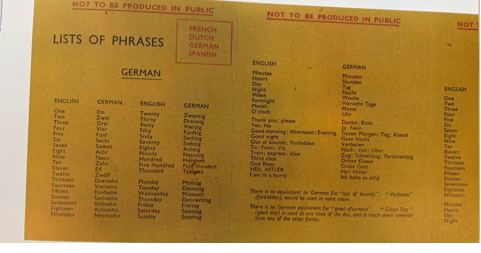
Daddy figured he could get by with his high-school French if he had to. He didn’t consider his tell-tale Tidewater drawl or his anxiety in a crisis that would mangle his grammar and word choice. Injured, hiding for hours, beyond vulnerable, Daddy tried to tell a Frenchman who seemed willing to help him that he was American and terribly hungry. He couldn’t remember the word for hurt. Rather than “Je suis American; j’ai faim,” he blurted, “J’aime American. Je suis femme.”
“Yank, what is wrong with you,” the Frenchman answered. “Oui, you like America. But you do not look like a woman to me.”
My father had a wonderfully self-deprecating sense of humor—like many of his generation—and he made me giggle when I was little by drawling “mercy buckets” for merci beaucoup (thank you very much). Under a War-Torn Sky readers will recognize that hint of my Daddy in Henry when he does the same thing with the young boy, Pierre, who takes him to safety in the Vercors.
A momentary sidebar about, well, words. I only had one year of French as a high school freshman (four years of Latin). So, to call me woefully inadequate linguistically is an understatement. But that lack turned out to be a weird bass-akwards (as my father would say) asset as a writer when creating the book. During my original research trip to France, I might catch a word I understood here and there in the torrent of conversation around me. That experience made my blood run cold with the thought: what if I were a lost flyboy catching—amid a torrent of words exchanged between people to whom I was entrusting my life—only these: soldats, Allemand, monnaie, bordure. Soldiers, German, money, border. Were these people planning to bribe German soldiers to get me to safety or were they planning to take me to the border and turn me in to a Nazi patrol for a money reward?
Henry’s boo-boo with the Frenchman turned out to be dangerous but not fatal. Other flyers were not as lucky.
Many a flyer was caught when a German soldier or “collabo” stepped heavily on his toes at a street corner waiting for traffic to pass, or managed a well-aimed whack with a briefcase to his groin. Such sudden, unexpected, sharp pain typically elicited a curse—in the suspected airman’s native language. More heartbreakingly, a friendly “good luck” offered in English when a flyer-in-disguise was stepping off a train could prompt a knee-jerk-grateful “thank you” from that scared boy.
So...to give my readers a tiny taste of that terrifying uncertainty, I included French dialogue. I carefully chose French words that are similar to English (monnaie vs. l’argent, for instance, for money), so readers can puzzle out meaning using contextual clues, just as Henry was forced to. With teens, a few phrases of untranslated French also felt a good eye-opener—perhaps their momentary discomfort would build empathy for classmates for whom English is their 2nd language. I didn’t realize inserting snippets of foreign dialogue would somehow be controversial! But, thankfully, my wonderful editor, Katherine Tegen, agreed that it was important to do.
Even more so now, I’d say. Cultural illiteracy is foolish and dangerous. The world has become a global society—what affects one nation spills onto the rest of earth-dwelling humans. WWII is history’s most poignant proof of that.
Henry’s Swiss handlers give him a copy of Jean-Jacques Rousseau’s La Nouvelle Héloïse to carry as a marker that’s he’s “the package” for his next escort. I chose it because it’s set around Montreux, a lovely resort city just across Lake Geneva from France. I knew from my father that the lake—as vast as it is, more like the Chesapeake Bay in terms of enormity—was how he crossed over to France.
The 18th century novel also offers a little symbolism for history/civics lovers—Rousseau’s arguments for individual liberty (“man is born free”) and a “social contract” (in which legitimate political authority rests solely on the consent of the governed) had so influenced our founders. The novel’s setting told Henry to exit at Montreux. But nothing else. He steps off the train into unknowns. Should he wait by the platform? Walk through the station? No one approached to claim him. No one in the waiting room or the men’s toilet or by the newsstand. Absolutely no one.
Henry (and my father) would come to learn that such alarming, heart-pounding delays and ambiguities were common along the resistance’s ever-shifting, improvised escape routes. To make it all worse, he can noodle out next to nothing in the swirl of German and French conversations all around him in Montreux’s train station.
Realizing a worried, thin farm boy clad in a tailored, sophisticated suit looked suspiciously incongruous, Henry forces himself to sit and read what bits and bobs he can understand in Rousseau’s narrative. Trying to discourage anyone talking to him. Trying to feign nonchalance. For hours. Passengers, soldiers, police come in and out in waves around him. Henry begins to seriously panic. Had his escort been arrested? What would he do if no one came for him?
Finally, in a flurry and fuss, an exquisitely dressed, middle-aged woman—perhaps the novel’s most epic character of all—flutters into the station. Spotting Henry, she dramatically throws opens her arms, warbling, “Cheri!” She rushes forward, catching him up in an embrace wreathed in expensive Parisian perfume to whisper in his ear, thankfully in English: “You are my nephew, visiting from school.”
She makes a fuss over kissing him on both cheeks, then wiping off the lipstick imprints with a lace handkerchief, all the while burbling in French and a breathy voice something about being late, something about a chocolate souffle, something about a cousin that Henry was supposed to know. She thrusts her poodle into Henry's hands, puts her arm through his and leads him toward the outside doors—all the while continuing her charade, even toggling flawlessly to German to charm Nazi guards at the exit. In her dramatic appearance and flood of praise about their protecting her country, the Germans completely forget to ask for their papers.
Her facility with many languages is the thing that saves Henry from arrest.
To learn more about the brave, bodacious, brilliant real-life women who inspired the character of the indomitable Madame Gaulloise, please go to the Resistance Passeur section.