
[ Back to Historical Fiction ] -> [ Back to Under A War-Torn Sky ]
Author’s Note
Under a War-Torn Sky
Under a War-Torn Sky is my leap from journalism to fiction. It was born in a request from my long-time editor at the Washingtonian for a “heart-warming” December holiday article. I wrote “human interest” stories for the magazine, profiles of people who had overcome unexpected trouble, people with special talents and dedication, people who had carried their families out of crisis with one-foot-in-front-of-the-other stubbornness. So, it made sense that he would ask me for something that would help renew people’s sense of holiday spirit and community. But I blanked—I couldn’t think of a thing. Thankfully, I eventually realized that one of the most moving stories I’d ever heard was that of my father’s WWII homecoming. Missing in action for months and feared dead, my father—unannounced—walked up the driveway of his parents’ farm, five days before Christmas 1944.
WWII is full of such poignant moments and moving storylines—truly life-or-death, humanity-threatening crises and people who met those challenges with profound courage and compassion. As Winston Churchill said of the Royal Air Force pilots who went up into the air night-after-night to face down Hitler’s armada of bombers raining hellfire on London: “Never have so many owed so much to so few.”
Historical fiction combines fact and imagination. Typically, the protagonist is fictitious, but the events, political figures, and issues of the book are true. The plot and the moral challenges the hero must face grow out of the time period. Details of everyday life need to be absolutely correct to bring the setting to life and to advance character development. For instance, when Henry is in the Vercors, the natives serve him walnut wine and blue cheese, common food in the region. Such idiosyncratic fare helped illustrate how unsophisticated and unprepared for foreign delicacies Henry is. The fact the American musician Louis Armstrong was so popular in France during the 1940s gave me a way for Henry and one of his teenage guides to connect. Singing together, they overcome their distrust and the language barrier between them. It also showed how young those boys were, how innocent really, in a bittersweet little scene of their pretending to play trumpets as they cross over a mountain pass, warily watching the sky for Nazi planes.
Readers always ask how much of Under a War-Torn Sky actually happened, how much is my father’s true story. Henry Forester is not my father. Henry does have my father’s resilient and kind personality and his amazing homecoming. His strained relationship with Clayton resembles that between my father and my steely grandfather, who managed to keep his farm during the Depression when neighbors all around him lost everything they had. My father did mangle his French once as Henry does with the old schoolteacher (I don’t want to give away how for those who haven’t yet read the novel). My father briefly met individuals like Pierre and Claudette (Patsy, the young woman Henry loves, is not my mother, by the way. She is purely my creation. My parents met after the war).
Henry’s odyssey is culled from the experiences of thousands of American airmen who had to bail out in Nazi-occupied territory but were lucky enough to be found by French freedom fighters. MI9, the British military intelligence secret service unit that helped Resistance movements establish underground escape routes, estimates that 4,000 British and American boys were saved by civilians who ran these lines. But MI9 also reports that for each of our flyboys who made it to safety—who lived to come home—one Resistance worker died. One for one. One life saved for one sacrificed.
Under a War-Torn Sky, then, is also the story of the teenagers, young children, women, and old men who risked everything to save downed and lost flyboys and to resist Hitler’s oppression.
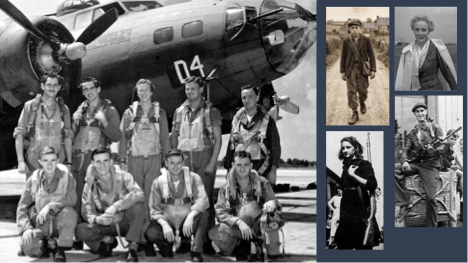
If these boys’ bomber was hit and they had to bail out over Nazi-occupied France, the only help they’d have to escape arrest and interrogation were the handful of French civilians who were willing to risk everything to hide and guide them along improvised escape lines. The photos on the right reflect the characters Pierre, Madame Gaulloise, Claudette, and maquis leaders who save Henry.
I learned of them by reading many memoirs. In these first-person accounts, I found the inspiration for characters like Madame Gaulloise. She is based on several cosmopolitan women who used their wit and chic elegance to intimidate and baffle the Nazis, among them Lucie Aubrac and a Parisian who went by Marie-Claire, the combined name of her two cats (and no, Madame Gaulloise’s clever poodle is not a factual dog. But using a nervous and rambunctious animal to distract the Nazis was a frequent tactic of the inventive and resourceful Resistance or maquis). To learn more about them, please see The Resistance, the Passeur section.
The Morvan maquis leader I named Martin is an amalgamation of many Frenchmen who had no military training but decided to take up the fight. One maquisard captain had been a veterinarian before the war. He began running a rat line when he was walking home from his clinic and literally ran into an American boy, dazed from bailing out of his burning airplane, dragging his parachute with him through the streets. The girl who helps Henry evade his prison guards on the train is based on a 20-year-old agent code-named “Michou.” She spoke several languages fluently and used that linguistic talent and quick-witted play-acting to guide 150 Allied airmen to maquis safe houses.
These courageous individuals typically acted alone, without the help or reassurance of a group. Often, they made split-second decisions to shield an American boy—and they were painfully young, our airmen were mostly between the ages of 18 to 24— pulling him to safety as a German patrol passed. Or they might be part of a loose network of valiant souls trying to move downed airmen through France to the Pyrenees and neutral Spain who would stand in the shadows for hours after curfew waiting to pick up a lost and frightened airman. That flyboy had been told simply to walk through the night along a particular road, that someone in their network (unnamed, unidentified, their whereabouts not disclosed) would claim them before dawn. Terrifying meetings for both that American and French resistant. What if that flyboy was actually a German mole who spoke impeccable English? What if that contact was not a passeur but a collaborator?
If caught helping downed Allied aircrew, these French civilians would be interrogated, their family and friends rounded up as well, and then executed. They put themselves and those they loved into terrible peril—all in the name of humanity and in mercy for that one American kid—while the majority of their neighbors remained passive or indifferent or even collaborated with the Nazis out of fear, greed, or because they agreed with Hitler’s hatred of Jews.
Amidst such cruelty and cowardice, real people exemplified by my characters Madame Gaulloise, Pierre, Claudette, and the old schoolteacher could still dream of a better world and better people. In the face of pervasive hatred and violence, ordinary people found within themselves an extraordinary and heroic mercy and generosity.
I traveled to France to better understand the landscape, the people of WWII, and what happened to civilians during the fight for liberation. I stood for a long time in front of one display in a small Resistance museum in the Morvan, just a few miles from Dun-les-Places, where the Nazis gunned down an entire village because a handful of them were members of the local maquis. I was transfixed by a wall of black and white photos of Resistance fighters and the villagers who helped them. I realized then, really for the first time, that had it not been for these brave people, my father might not have survived. I and my children would not exist.
What haunted me most were the clear-eyed, hopeful faces of several teenagers who disappeared, never to be found. Also displayed is a letter by a 23-year-old Paul Sarrette, who was killed by the Nazis. He wrote, “I am going to fight, not for a word, not for glory or for a flag, but for you...so that you may live without knowing the horrors of a war.”
Leaving the museum, visitors pass under an arch that states: “May you think sometimes of the reasons you are free.”
I hope Henry Forester and Under a War-Torn Sky do that for you.
For more about the novel, the real-life people who inspired its characters, and how you can learn more about our flyers and the French Resistance, please see adjacent sections.
WWII is full of such poignant moments. If you know someone who survived it, turn on a tape recorder and encourage him or her to share with you.
