
[ Back to Historical Fiction ] -> [ Back to Under A War-Torn Sky ]
The 8th Air Force
Under a War-Torn Sky
A note: Under a War-Torn Sky focuses on the bombers flying out of England over Nazi-controlled Europe—it does not cover the courageous crews fighting in the Pacific, North Africa, or the legendary Tuskegee Airmen.
American aircrew arrived in England in late summer 1942 to work in tandem with the Royal British Air Force. The RAF had already been bravely battling—all alone—the Luftwaffe for two long years during Hitler’s constant bombardment of London (that would kill 43,000 British civilians). Our crews flew daylight “precision” raids, the Brits nighttime sorties.
The 8th's mission was twofold. First, to break down the Nazis’ terrifyingly productive war machine by bombing munitions and equipment factories—in early 1943, for instance, a new, ready-to-fly Luftwaffe fighter plane rolled off a German production line every hour. Stalling that required our boys to fly deep into France or Germany to target things like ball-bearing plants, factories the Third Reich buried in civilian areas to try to hide them. The second life-or-death goal: to gain air superiority so that when our troops landed en masse on a French beach (D-Day) to invade Hitler’s “Fortress Europe,” they wouldn’t be massacred from the air by Luftwaffe bombs and strafing.
Our Aircrew: Who They Were and What They Faced
Here’s a thumbnail portrait of our flyers and the harsh realities of their rattletrap B-17 and B-24 bombers.
During our conflict with the Nazis, our Air Force bomber crews—boys on average 19 to 24-years-old—had to fly 25 missions to complete their tour of duty and be sent home. Each mission required surviving hours of attacks by nimble and deadly Luftwaffe fighters and flying through flak—searing explosives jettisoned into the air in thick clusters. Only one in four of those boys ever completed their tour. More—one in three—perished in the air or in their base hospitals from their wounds.
The fatality rate among our young flyboys was heartbreaking. If you’ve watched Masters of the Air, which I highly recommend, you’ll have heard 32 of the 35 original aircrews of the 100th Bomb Group showcased in the series who arrived in England in fall 1943 never made it back to base (once P-51 Mustang planes were developed and could begin escorting our bombers long-range in 1944, the survival rate improved somewhat).
A staggering total of 51,000 American flyboys would go missing, shot down over Nazi-occupied lands. About half who managed to bail out of burning planes were captured and interned in Hitler’s stalags (approximately 28,000).
It is less clear exactly how many—often badly hurt, certainly terrified, and all alone—tried to evade Hitler’s troops and sympathizers and make their way to neutral territory in Switzerland or Spain. Most died in the attempt, lost and frozen on snow-deep mountain ranges, dying of shrapnel or bullet wounds, executed as spies, or beaten to death without any record of who they were.
What is clear is that those who evaded capture and survived were lucky and rare. And they didn’t do it alone. MI9, the British escape service that helped Resistance groups establish underground “rat lines,” calculated that about 4,000 British and American servicemen were spirited out of Belgium, the Netherlands, and France along these civilian-devised and run escape routes. Ordinary people who stood up to brutality by extraordinary acts of kindness and generosity, taking in lost flyboys, often bloodied and dazed from parachuting out of their planes who happened to wander onto their farmlands or villages. They hid, guided, and shared what little food they had—risking everything in that singular act of humanity. One young man at a time.
But each successful escape carried a terrible price. MI9 also estimated that for each Allied airman led to safety, one of those Resistance workers died. Caught by the Gestapo—they would be interrogated, tortured, then deported or executed—usually in public to terrorize and break French spirit. One for one. One truly horrible death for one American life saved. Under a War-Torn Sky is as much their story as Henry Forester’s (for more on the Resistance and the brave people who helped our flyers please see The Resistance).
In his wonderful nonfiction book The Wild Blue, which released the same autumn as Under a War-Torn Sky, Stephen Ambrose introduces the aircrew of B-24 Liberators: “They came from every state…were young, fit, eager. Some had an excellent education…others were barely, if at all, out of high school…Many were farm boys. They plowed behind mules…relieved themselves in outdoor privies. They walked to school, one, two, or sometimes more miles. Most, including the city kids, were poor. In the summertime many went barefoot…Many had never been out of their home counties. Almost none had ever been up in an airplane…But they all wanted to fly…to get off the ground, be like a bird, see the country from up high…They were astonishingly young. Some never got to be 20 years old…Anyone over 25 was called ‘an old man.’ In the 21st century, adults would hardly give such youngsters the key to the family car, but in the first half of the 1940s, the adults sent them out to play a critical role in saving the world…”
It felt as if Ambrose had read my manuscript—his descriptions so match my father and the “everyman” character he inspired. Henry Forester is a poetic-hearted farm boy who tapes a sonnet proclaiming the sublime joy of flying above his Quonset-hut bunk. "High Flight"—“Oh, I have danced the skies on laughter-silvered wings…”—was written by John Gillespe Magee, an American pilot with the Royal Canadian Air Force, and sent home in a letter to his parents in September 1941.
Tragically, a few months later, Magee was killed in a mid-air collision with another plane trying to group up in the thick clouds over England. “Being in the soup,” as my father and other flyers described trying to climb through England’s thick cloud cover to form in tight formations before crossing the North Sea was one of many dangers of their missions. Weighted down with bombs and full tanks of gas, shuffling about one other, unseeable, sometimes coming out of foggy murk within feet of another plane, more than a few crashed into one another and exploded. Such was the tragic accident that killed the young poet Magee. He was only 19 years old.
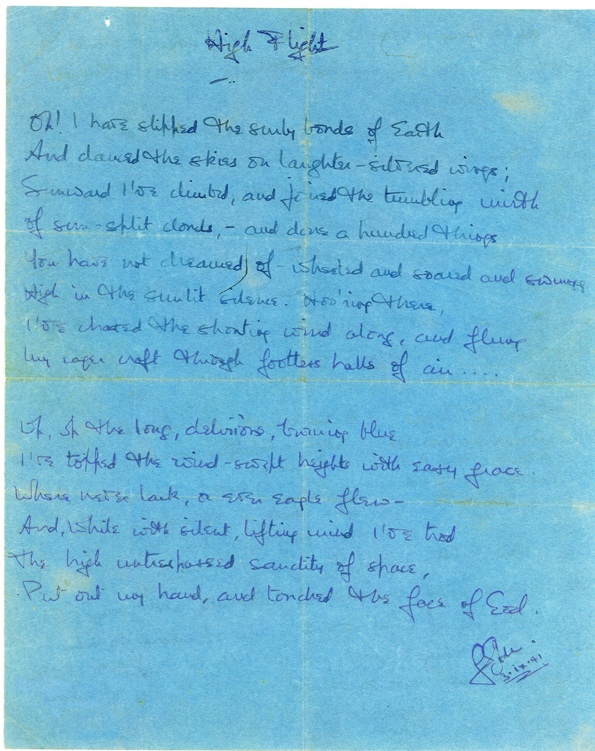
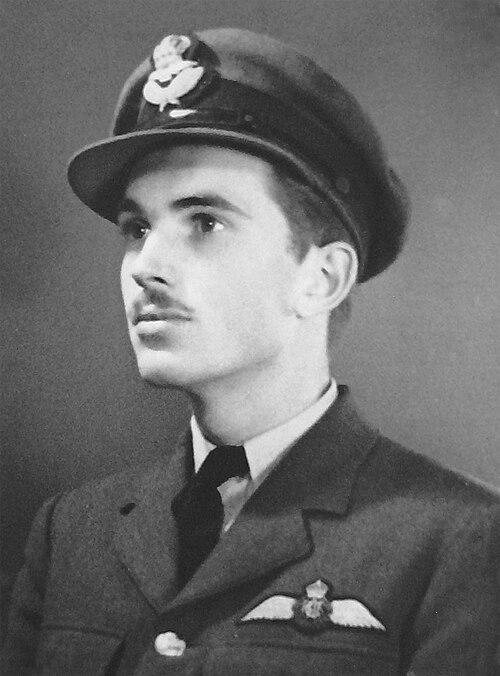
Such boys and my father (who could still recite "High Flight" in the hospice before he died) had no idea what they were going to face up there in the “sun-split clouds” that so beckoned their hearts.
Or in those tin-can planes.
The hull of a bomber was only a half inch of aluminum. A kid with an attitude and good swing could’ve bashed it open with a baseball bat. Flak—boiling, spinning fragments from explosions shot from German anti-aircraft cannon—sliced viciously through the hull to where our boys sat.
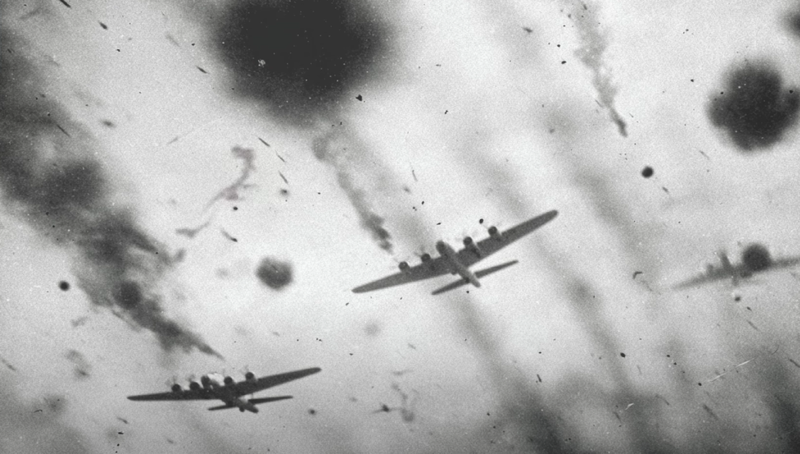
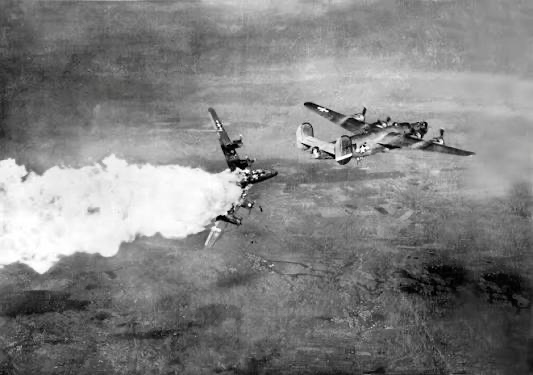
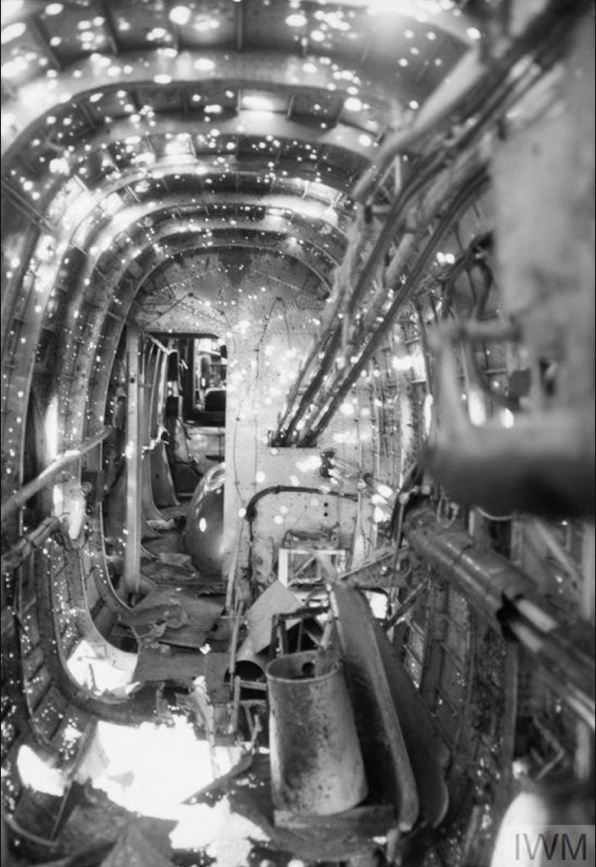
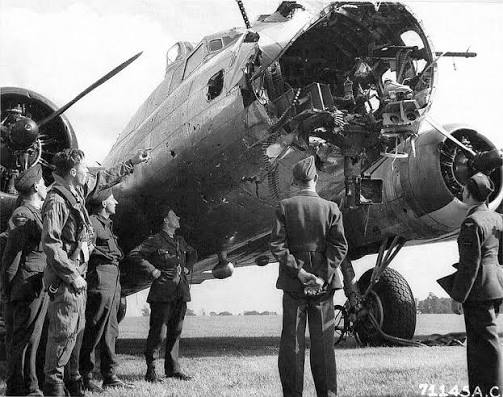
Flak shot from Nazi anti-aircraft guns on the ground and its deadly damage. (Images courtesy IWM)
Actor Jimmy Stewart put his Hollywood career on hold to serve with bombers in WWII, earning the Distinguished Flying Cross and Service Medal and the French Croix de Guerre. He flew twenty B-24 bombing runs over Nazi-occupied Europe in the lead up to D-Day. On one of those flights, flak tore through the wheel well of Stewart’s plane, destroying his parachute and map case, and blasting a hole in the floor between him and his co-pilot. They flew on, buffeted by winds and an unnerving view at their feet straight down to the German countryside miles below. When they did straggle back and land in England, their shrapnel-riddled plane cracked in half.
In that steady, matter-of-fact deadpan he was known for, Stewart said to the ground crew chief helping his mates out of the wrecked plane, “Sergeant, somebody sure could get hurt in one of these damn things.”
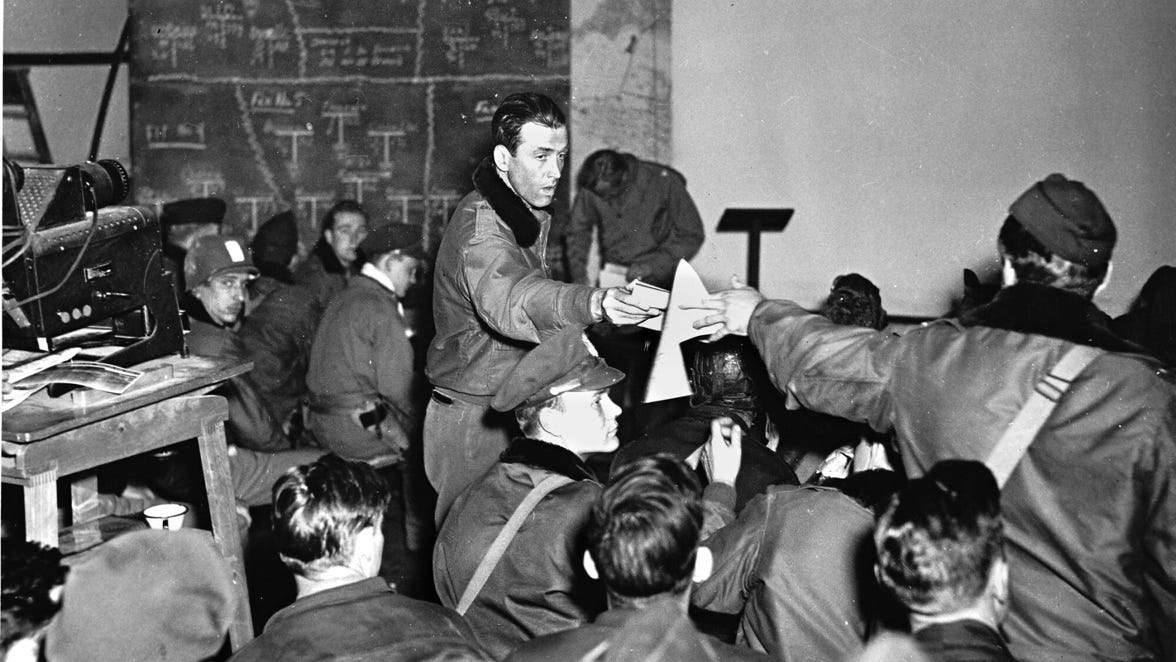
No wonder what we now know as Post Traumatic Stress Disorder (PTSD)—lingering triggers/symptoms of trauma events—was called “flak-happy” during WWII. Stewart, for example, struggled with the emotional toll of having flown all his bombing missions—insomnia, recurring nightmares, and severe weight loss. For many—including my father—the effects lasted a lifetime. Several years ago, a 92-year-old gentleman, who’d served as a bombardier, told me he still woke up in a cold sweat sometimes, smelling the smoking, burning oil of flak.
The bombers had no heat, no pressurization, their guns pointed out open bay doors—meaning its crew had to survive temperatures as low as 40-degrees-below and wild winds whipping around them. As soon as they reached 10,000 feet, they strapped on bulky oxygen masks that reeked of sweat and rubber. Every 20 minutes—in the middle of bloodcurdling air-battles with Messerschmitts rocketing toward them with their machine-guns blaring—the co-pilot had to call over the intercom: “Crack down your lines, boys.” The spit from their shouting out to one another could freeze, block their airflow, and cause them to pass out.
To protect themselves from frostbite, under their massive fleece-lined leather flight suits, our crews wore long-johns wired like electric blankets that plugged into the electrical circuitry of the plane. Sound cozy? Flyers hated them. If a direct hit of flak sent an electrical surge through the plane, that shockwave went up the line straight to their underwear, singeing their skin.
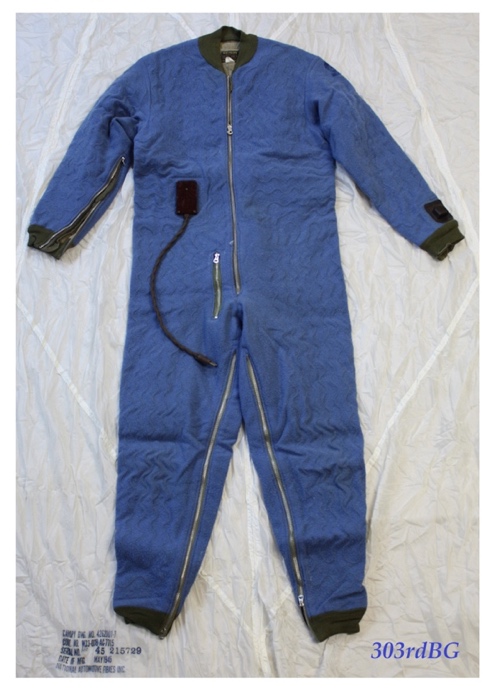
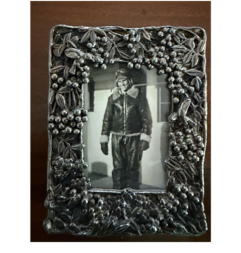
The heated “blue bunny” suit, over which went shearling-lined leather pants and jacket. My father in his complete flight gear in late 1943.
Given the fact the average life span of crew members—in terms of making it back to base in one piece—was only 15 of the required 25 bombing raids, our flyboys were fervently superstitious. They tucked good-luck charms into their pockets that became sacrosanct talismans for survival. I gave Henry a “cloud marble” (it’s featured in the new and truly marvelous Under a War-Torn Sky book trailer—an “Easter Egg” for readers who already know and love the novel and its sequel, A Troubled Peace).
As a child, my father played marbles with his own stern, Depression-era, chicken-farmer father. I sensed Henry carrying a marble he’d won off his dad could be a small but crystalized “revealing detail” that his action-packed escape was also a journey of redemption—replacing his father’s harsh demands and assessments with his own beliefs and self-definitions. I didn’t want to trip into any anachronistic or inauthentic language, so I found a handbook about marbles (no Google search back then, friends). That’s the power of research to spark a writer’s imagination! That handbook is where I learned about clouds—end-of-day “shooters” made up of leftover scraps of different colors, like the edges of dough left by cookie-cutters. Re-blowing those bits and pieces into a new orb created a slightly larger, milky-colored marble with threads of blue and rose, like a cloudy sunrise. A perfect, meaning-rich good-luck amulet. And turns out, the thing that helps Henry find Pierre—the boy who saved him—in A Troubled Peace.
A few final words about those rattletrap planes: there was no “power steering” in any of the cockpit’s controls. It took pilots’ brute strength to fly them. The foot pedals, for instance, controlled rudders that turned a plane right or left. Holding a tight-tucked, combat-box formation for maximum protection against Luftwaffe fighters swarming them—against headwinds and propwash from adjacent B-24s—required pilots to brace those pedals firmly in place with their feet for hours at a time. They developed incredible thigh muscles—but could be so physically depleted at the end of a mission, they couldn’t stand up. Crews often had to lift pilots out of the cockpit and onto the runway tarmac.
Our Air Force flew “precision daylight” missions (versus Britain’s RAF nighttime raids), optimizing our navigators’ ability to locate and bombardiers to drop a B-24’s 8,000-pound payload of explosives “right in the pickle barrel”—NOT on civilian neighborhoods in which the Nazis insidiously tried to hide their munition factories. Our planes—shimmering in sunlight, banners of contrails formed in the cold high-altitude air streaming along behind them—were visible for miles. Easily tracked and attacked from the ground and from the air.
If their planes were hit, flyboys able to parachute out in one piece drifted down through raging, hellfire-loud air battles. People on the ground could see and follow those bright-white plumes as they descended, and German patrols and collaborators hurried out to hunt them.
From that moment on, whomever our lost boys next encountered made all the difference between their living or dying, capture or escape (see The Resistance and Why French Dialogue? sections).
What Happened if a Flyer Came Near Switzerland?
When sketching out his narrative, I decided Henry’s plane would go down where so many of our flyers did—in Alsace-Lorraine, France’s northeastern corner that borders Belgium, Luxembourg, Germany, and Switzerland. Elbow-to-elbow with so many other countries, the region was a polyglot of cultures, languages, and loyalties. Such a melting pot could be even more discombobulating for a downed flyboy because streets, shops, posters might be in German or French, perhaps both. Leaving no clue for that lost boy of where he was or how many enemies to fear.
After hitting the ground hard, mangling his ankle, Henry can only limp along in a half-jog, as easy for German soldiers or collaborators to overtake as a wounded bird. But he has the incredible good luck to stumble (literally) upon one of those extraordinary French people who will decide—in a stunning, split-second act of bravery and generosity—to help a lost, hurt American flyboy.
Such saviors were seldom the Hollywood-stereotype of hardened, gun-toting men in cocked berets, cigarettes dangling from sardonic smirks. No, our flyboys owed the most to old men, teenagers, children, and women (so many women—who ironically didn’t have the right to vote in France yet but truly were the heartbeat of their homeland’s resistance and escape routes). The life-or-death risks fell to them because military-aged Frenchmen were gone. After France fell to Hitler’s 1940 blitzkrieg, 1.8 million French soldiers were marched to Germany as POWs and used in forced labor for the entire war.
My French characters are archetypes—amalgamations of real-life people our flyers remember in hushed, emotional gratitude. Like the elderly schoolteacher who finds Henry in Alsace-Lorraine. That scene is powerfully depicted in this new book trailer. For students and people interested in how a book trailer is made, its director, Alexander Sharp, talked with my son (and fellow novelist) Peter Malone Elliott which you can view here. The two were film students and BFF roommates at Loyola Marymount University and straight out of college created a stunning, Hitchcock-style feature film now streaming on Amazon.
In the novel, the schoolteacher mutters that he’d stood by—“an old man’s fear”—when the Nazis rounded up his students for compulsory labor. Helping Henry will be a small counterweight to his guilt. He hides Henry in the school’s loft, cautioning silence: “I do not know what townspeople would do to you. Many welcomed the Germans. And you Americans bombed Mulhouse very badly.” His plan: smuggle Henry into Switzerland, on a raft stacked with cabbages a friend will float down a canal to market in Basel.
It turns out to be a harrowing boat ride—the first instance of Henry’s escorts having to think fast and play act convincingly when confronted by armed guards. A clever mind, a ruse, and nerves of steel their only weapons.
How safe will Henry be in Switzerland? Well, the guards who threaten the schoolteacher and nearly impale Henry in his hiding hole as they bayonetted cabbages are Swiss, looking for refugees to turn away or arrest.
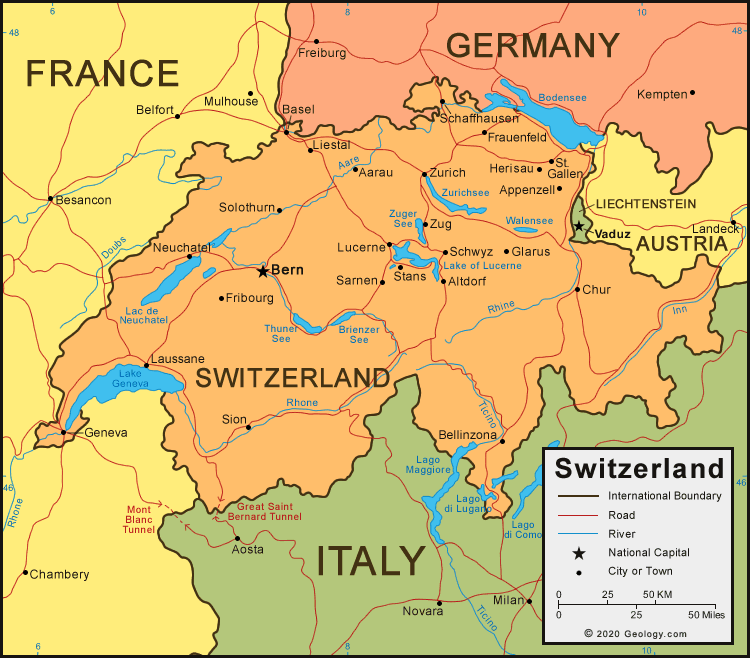
Technically, Switzerland was neutral. But here’s the context: it’s tiny—basically the size of Vermont and New Hampshire combined, 3/4ths of its border butts up against what were Hitler’s Axis alliance. So much of its terrain are vaulting, snow-covered Alps—where very little can be farmed and produced (other than their legendary cheeses and milk chocolate for grazing cows).
As a result, most of Switzerland’s foods, fuel, and raw materials must be imported. In the 1940s, supplies came primarily from Germany and Italy. To keep the Nazis and Mussolini’s fascists from invading and coal supplies still coming, the Swiss signed a trade agreement to allow Axis trains to cross in and out of Switzerland.
More infamously, the Swiss served as bankers for Hitler’s Reich, holding gold reserves, artworks, jewelry, and cash plundered from Jews and nations the Nazis occupied. They enforced a strict “Das boot ist voll” (the boat is full) policy of turning away refugees, particularly Jews. In 1995, the Swiss finally acknowledged complicity in the Holocaust, declaring “a considerable burden of guilt.”
Our state department does credit Switzerland with taking in—or allowing to pass through to other destinations of safety—about 400,000 emigrants over the course of the war (there was, for instance, a police chief named Paul Grueninger who defied orders and aided about 3,000 Austrian Jews in escaping into Switzerland).
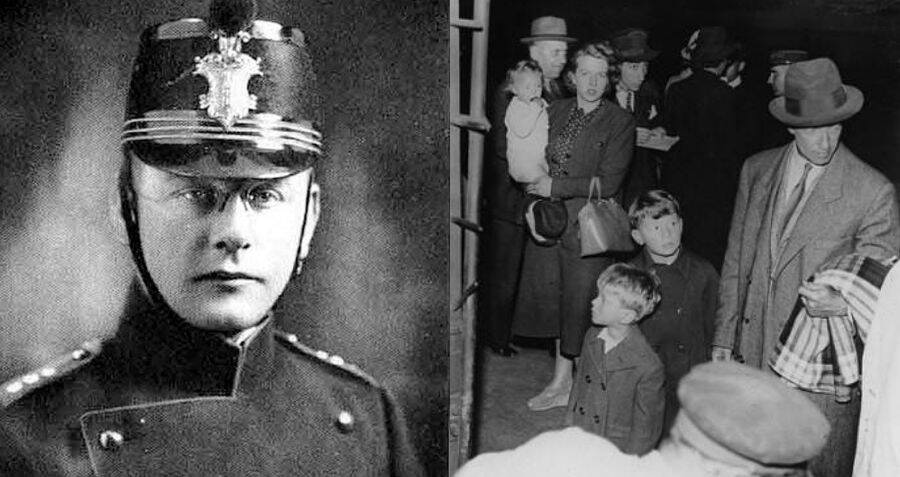
Paul Grueninger and refugees his countrymen turned away, but he might help.
Switzerland did safeguard our downed pilots from Nazi arrest and interned them (about 1,500 by war’s end)—along with Luftwaffe pilots who’d also bailed out over Switzerland. But the Swiss Air Force sometimes fired on American bombers already ablaze and damaged from German flak that our pilots had turned toward the Alps, desperate to emergency land on neutral ground.
The Swiss interned our aircrews in Adelboden, a vacant summer resort, ringed by mammoth peaks, reached by a single, narrow, patrolled road. Escape on foot was impossible. Only a trained mountain climber with the right equipment stood a chance. Our flyers were put in converted hotels and allowed to walk about the resort during daylight hours. Cushy by comparison to German stalags. But food was rationed to black bread, potatoes, and watery soup and many flyboys suffered malnutrition. There was no heat, so they remained in their flight suits and gloves most months. Hot water for showers turned on once every ten days.
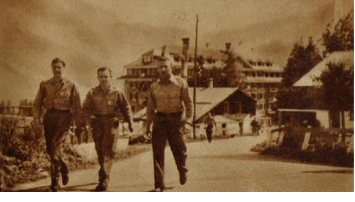
American airmen in Adelboden.
If our interned flyers did try to escape, didn’t die in a snowdrift, and were caught, they were sent to a hellish prison camp called Wauwilermoos, run by a sadistic, Nazi-sympathizing commandant.
The only real chance to flee came while being processed, quarantined, or treated for injuries in Bern—before being transported to Adelboden by train.
Because of its neutrality, Switzerland was also an epicenter of spying, one embassy on another. That brought American diplomats to Bern who had more than a few underground contacts, knew a thing or two about being clandestine, and could create official-looking identity papers.
Here’s one of the handful of plot twists in which my father’s and Henry’s stories coincide.
While he was in Bern, a man from the American consulate required my father sign a paper promising to cooperate with Swiss authorities and not try to escape. The next day a different official came, asked Daddy if he wanted to get home and was willing to take some chances, adding, “We need all the pilots we can get back.” My father never knew the second man’s name, just that he called himself “Uncle Sam.”
So, I had an “Uncle Sam” visit Henry in the hospital with the same question and gave him the fictious last name of Watson.
Through recently declassified material from the National Archives, I’ve confirmed “Uncle Sam” being a Sam E. Woods, an embassy attaché who not only managed to sweet-talk German officials into passing him secret information that he got to London, but also helped internees attempt escape. Raised in Mississippi, with a father who worked as a mill operator, Woods hardly seemed predestined to become a cosmopolitan spy. But like thousands of people whose WWII experiences completely changed their life plans and visions for themselves, Woods’ service in WWI had propelled him into the diplomatic corps in Europe. 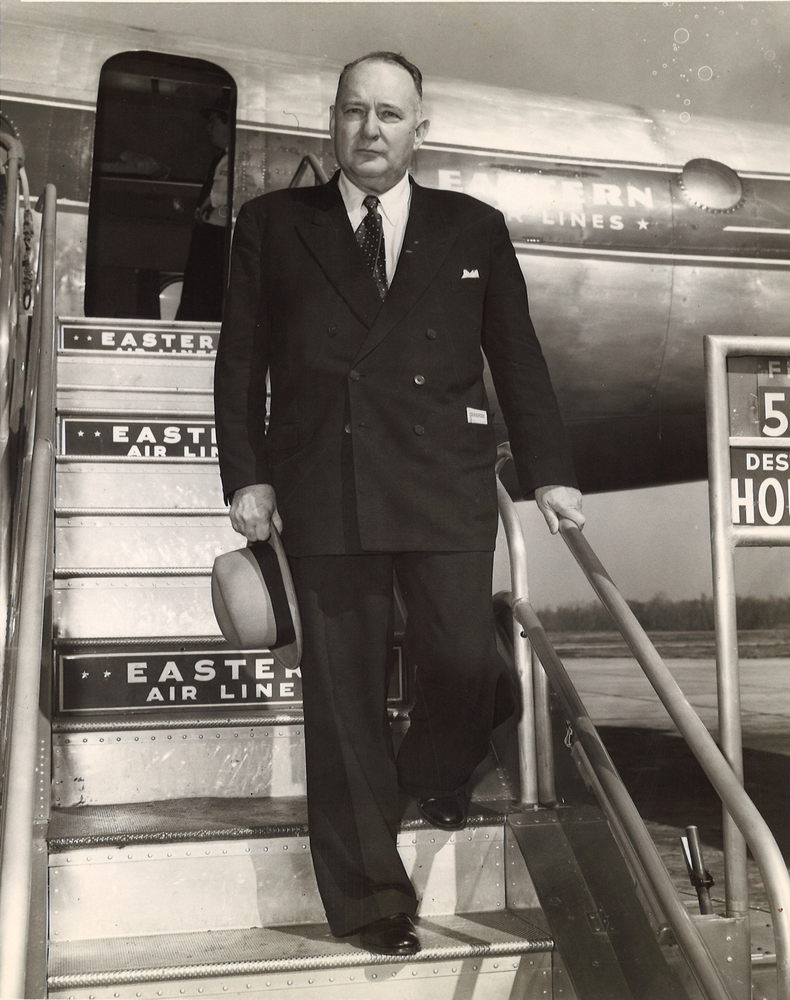
In Bern, for our flyboys willing to brave the risks, Woods might get them forged Swiss papers, maybe even hide them in his apartment for a few days or at a dinner party, before providing them their underground contact. There was a patchwork of safe houses and guides, Swiss civilians willing to give flyers cover in public spaces or at train stations, perhaps even go with them through a checkpoint.
Of course, after that, no guarantees of anything. The majority of Swiss people, in fact, were of German descent, many of them members of local Nazi groups. In Under a War-Torn Sky, Henry ends up on a train heading to Adelboden, escorted by a Swiss guard, with no idea what was supposed to happen next. Which was typical.
The Dangers of Trains and Trolleys
Despite the obvious risks of putting a downed airman on a train packed with travelers of all types— including Nazi soldiers—the Resistance often did just that. And many times, that American kid rode alone—only told which station to disembark at or given the vague promise someone would connect with them on the train, and—pour l'amour de Dieu—do not speak.
Many a flyer was caught when a German soldier or “collabo” stepped heavily on his toes or managed a well-aimed whack with a briefcase to his groin. Such sudden, unexpected, sharp pain typically elicited a curse—in the suspected airman’s native language.
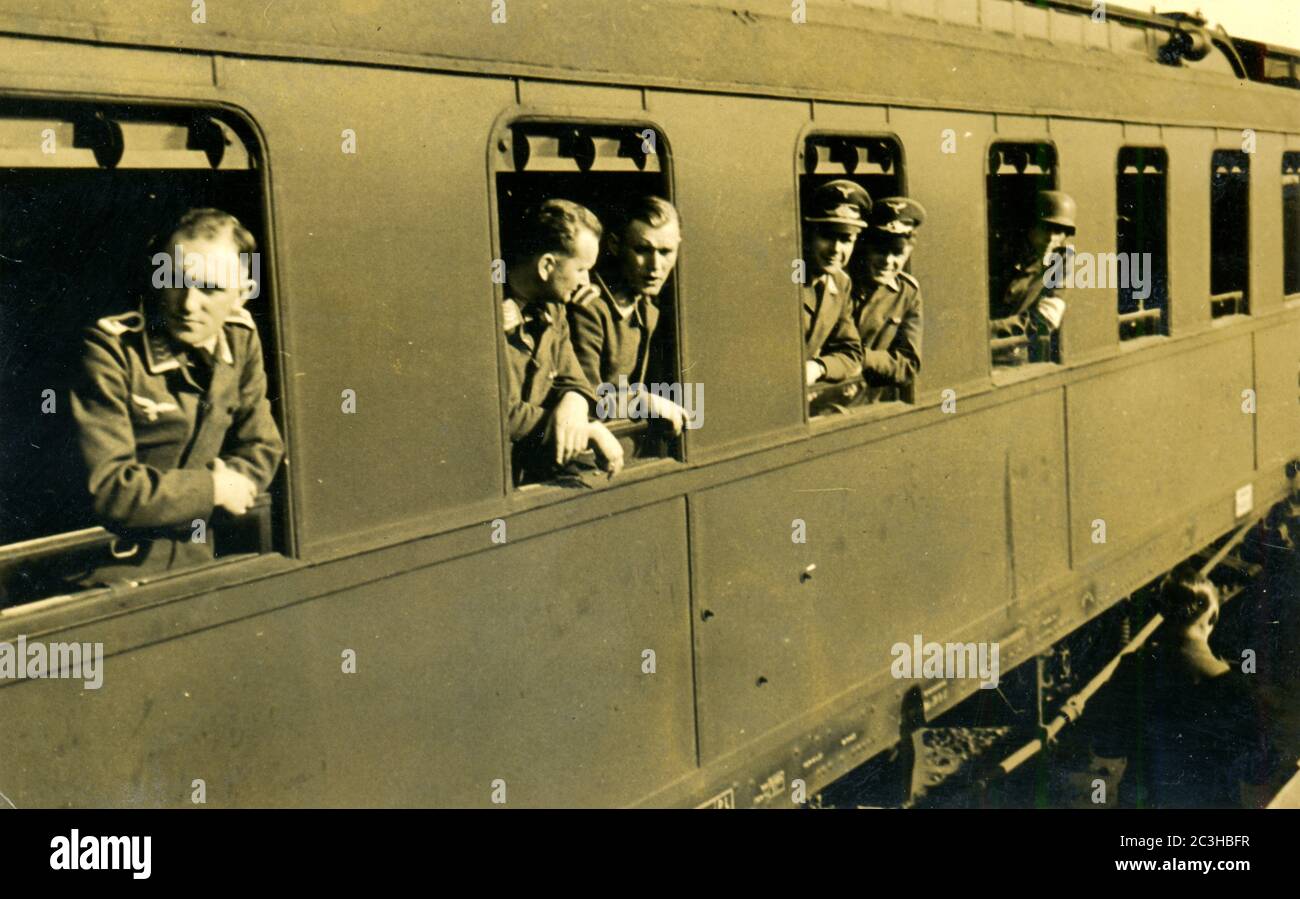
German soldiers crowding a French train
There could be saviors hidden among the throng, sometimes planted to keep an eye on the flyboy from a safe distance. Or they might simply be a citizen with a keen eye taking pity on a young airman to warn him. My father never knew which applied to the man who once saved him from sure arrest.
Daddy was standing on a trolley, jam-packed with Nazis, steadying himself by holding onto one of its dangling ceiling hooks. He was disguised as best he could be in ill-fitting civilian clothes, which included wooden-soled shoes (the Nazis had confiscated all rubber for their truck and car wheels, leaving French citizens to struggle along cobblestone streets on bicycles with wooden wheels and wearing wooden clogs—which were incredibly hard to run in and certainly not quiet when trying to be stealthy).
Daddy hadn’t thought about his aviator bracelet (an airman’s wings and small wrist chain) that his mother had given him when he graduated from flight school. He and she were close, and her gift precious to him. But it was also a dead giveaway.
He’d been told to avoid eye contact. To gaze out a window or study the floor. But like most 20-year-olds stuffed into a small compartment with his enemies, he couldn’t help nervously glancing around. Thank goodness he did.
Across the aisle, a Frenchman stared at him overtop his newspaper. When the man caught Daddy’s eye, he frowned, pointedly took his gaze to my father’s hand holding onto the hook, then down again, shaking his head ever so slightly. Daddy realized his winged bracelet was exposed on his wrist! He dropped that arm and lifted his other hand to grasp the hook. The man smiled and went back to reading his paper.
They never exchanged a word. The man got off the tram at the next stop, without a backward look, pushing his way past German soldiers. When Daddy exited three stops later, he dropped the beloved bracelet down a gutter’s grating.
To see what awaited our flyboys if they made it to France, go to: The Resistance and Why French Dialogue?.
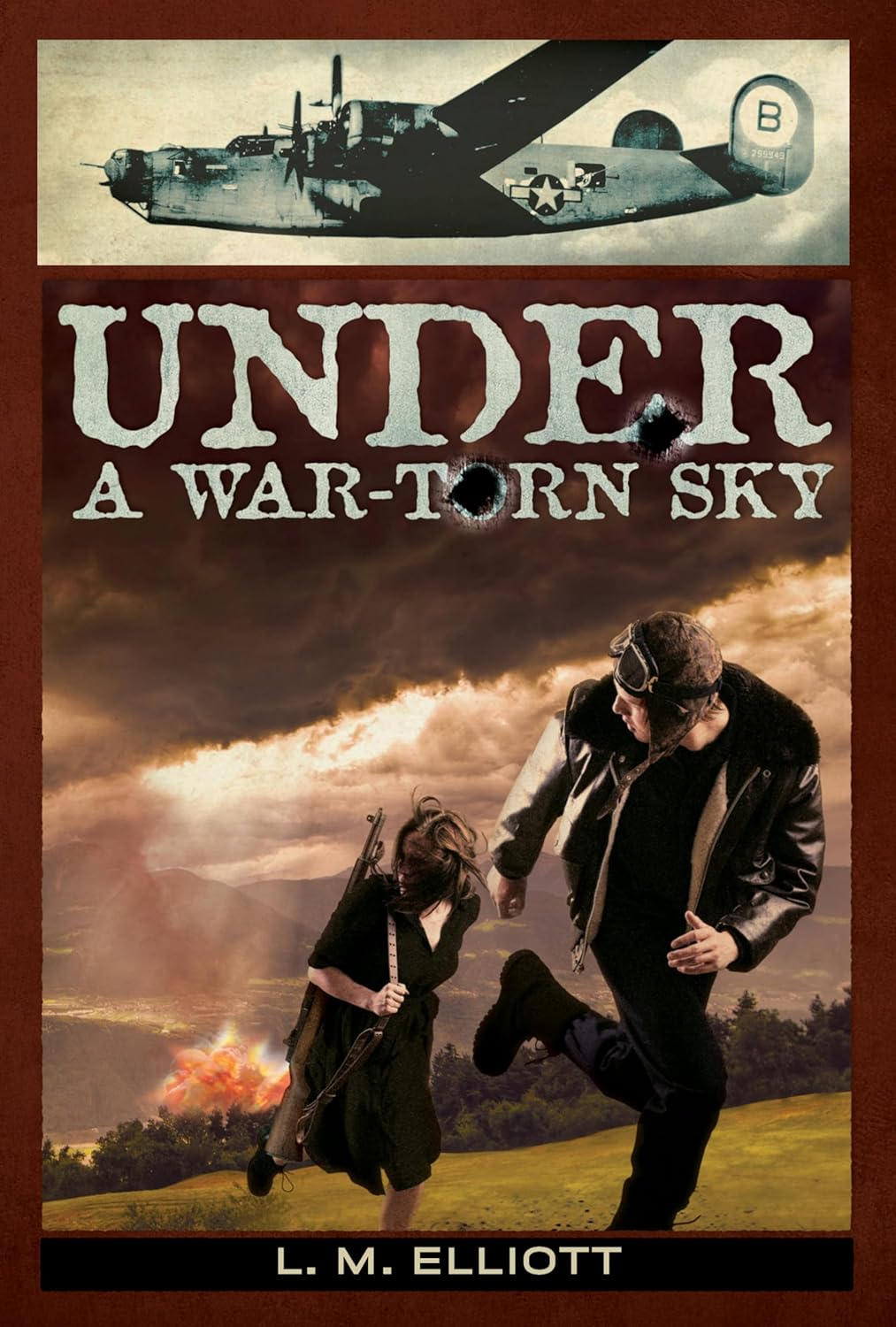
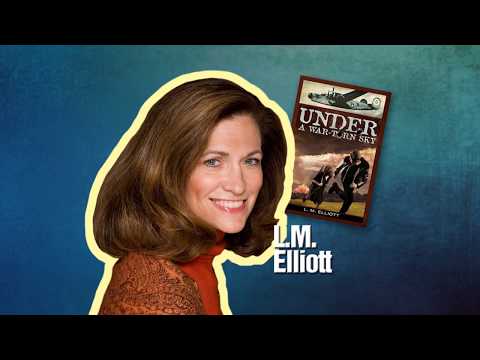
Under A War-Torn Sky Book Talk and Read-Aloud with FCPS TV
In this mini-talk and reading of UNDER A WAR-TORN SKY, L. M. Elliott talks about how well-researched period fiction humanizes history, bringing it alive through the compelling story of individual characters. She reads a chapter in which Henry Forester has his first encounter with the French Resistance as they help him escape from a train, asking the listener to count the "maquisards" involved in the getaway.
Watch Now